
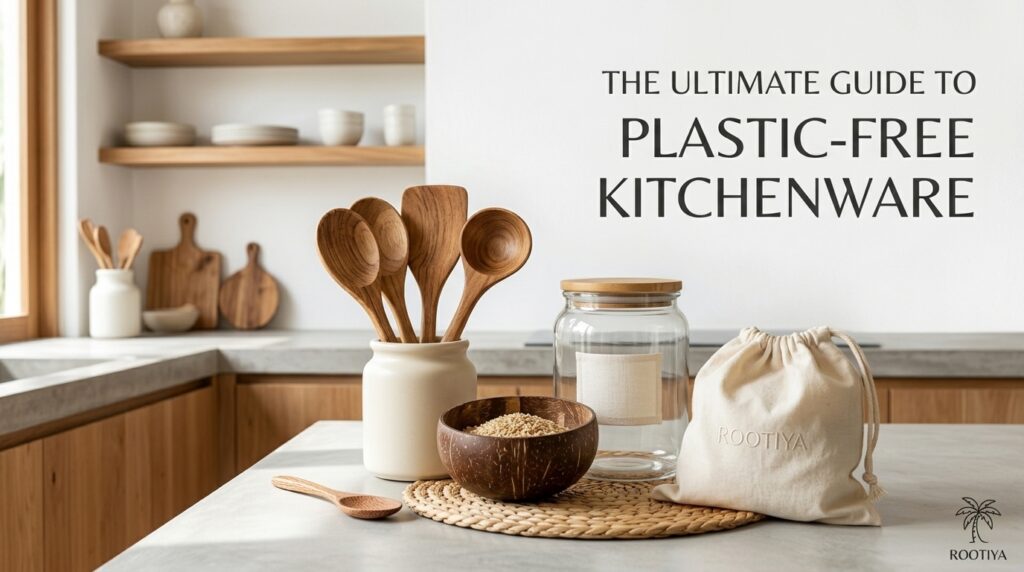
Think about the first ten minutes of your morning. The kettle, the spoon that stirs your tea, the container holding last night’s leftovers, the cutting board beneath your knife. In most kitchens, plastic is woven quietly through all of it. It’s so familiar that we rarely notice it, and rarely ask what it does when it meets heat, acid, and time.
A quiet shift is underway. More households are treating the kitchen as the heart of a considered, low-waste life, and choosing pieces that are as beautiful as they are honest: a hand-turned wooden spoon, a coconut shell bowl with a soft, burnished glow, a heavy stainless steel pot that will outlast the decade.
This guide walks you through why plastic-free kitchenware is worth the switch, which swaps make the biggest difference, how to care for natural materials, and how to bring it all together into a kitchen that feels calm, warm, and unmistakably yours.
Why Make the Switch to Plastic-Free Kitchenware?
What Happens When Plastic Meets Hot Food
Plastic is wonderfully convenient, but it is not inert. Research has raised consistent concerns about two things in particular:
- Chemical leaching. Some plastics contain additives such as bisphenols (including BPA) and phthalates, which are used to add rigidity or flexibility. Studies show these compounds can migrate from plastic into food and drink, and that heat, fatty foods, acidic ingredients, and repeated washing can increase the effect. Many products are now labeled “BPA-free,” but this doesn’t tell you what replaced it, and some substitutes are still under scientific review.
- Microplastics. With everyday wear, such as chopping on plastic boards, scraping with plastic spatulas, and scrubbing, plastic surfaces shed microscopic particles. Research on the long-term health effects is still developing, but many people find that reducing avoidable exposure is a sensible, low-cost precaution.
You don’t need to be alarmed to make a change. You simply need to be curious about what touches your food, especially when it’s hot.
The Environmental Case: Made to Last
Plastic kitchen items are often designed for a short life. They warp, stain, crack, and get replaced, and most end up in landfill or the wider environment, where they persist for generations.
Natural and durable materials tell a different story:
- Longevity. A well-made stainless steel pan or a properly cared-for wooden utensil can serve a household for many years, often decades.
- Lower long-term waste. Buying fewer, better things is one of the simplest forms of sustainability.
- Renewable or repurposed sources. Materials like coconut shell are often a by-product of the food industry, given a second life as functional art.
- Graceful aging. Wood deepens in tone, steel develops character, and ceramic holds its glaze. They look better with use rather than worse.
Choosing sustainable home goods isn’t about deprivation. It’s about trading disposable for lasting.
Essential Plastic-Free Swaps for a Conscious Kitchen
You don’t have to replace everything at once. Start with the items you use most, particularly anything that touches heat, and build gradually.
Cooking Utensils
Utensils are the ideal first swap, since they spend the most time in hot pans and pots. Look for non-toxic cooking utensils made from:
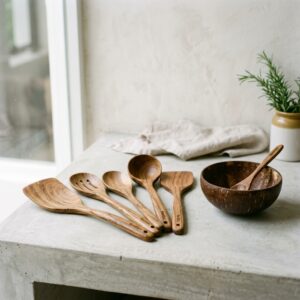
- Neem wood: A dense, fine-grained hardwood traditionally used in South Asian homes. It’s sturdy, gentle on cookware, and prized for its natural resilience.
- Bamboo: Fast-growing and lightweight, with a clean, pale look. Choose solid, single-piece bamboo and check that it isn’t bonded with resins or melamine glue.
- Stainless steel: Excellent for high-heat tasks, flipping, and serving.
Wooden spoons and spatulas are kind to stainless steel, cast iron, and ceramic surfaces alike.
Food Storage
Storage is where plastic tends to pile up. Consider these alternatives:
- Glass containers: Non-porous, so they don’t absorb odors or stains. Ideal for leftovers, meal prep, and pantry staples.
- Stainless steel tiffins and lunch boxes: Light, unbreakable, and perfect for on-the-go meals.
- Ceramic crocks and jars: Beautiful for counter-top storage of salt, sugar, and cooking essentials.
Swapping just your reheating containers to glass or steel removes one of the more common routes of plastic-heat contact.
Bowls and Servingware
This is where function meets beauty:
- Coconut shell bowls: Each one is polished by hand and slightly unique, with a warm, organic finish. They’re wonderful for smoothie bowls, salads, and snacks.
- Ceramic and stoneware: Timeless for everyday dining, with a weight and texture that make ordinary meals feel considered.
- Wooden serving boards and platters: Natural centerpieces for cheese, bread, or a shared table.
Prep Accessories
Small tools quietly add up:
- Wooden or bamboo cutting boards: Kinder to knife edges than glass or stone, and free from plastic shedding.
- Stainless steel colanders and mixing bowls: Durable workhorses that stack neatly.
- Natural-fiber brushes and cloths: Look for plant-based bristles and cotton or linen to replace plastic sponges and brushes.
A Quick Guide to the Materials
| Material | Best For | Why It Works |
|---|---|---|
| Neem wood | Spoons, spatulas, boards | Dense, durable, gentle on cookware |
| Coconut shell | Bowls, ladles, spoons | Lightweight, upcycled, distinctive finish |
| Stainless steel | Pots, storage, prep tools | Long-lasting, non-reactive, easy to clean |
| Glass | Storage, baking, serving | Non-porous, no odor or stain retention |
| Bamboo | Utensils, boards, trays | Renewable, light, minimal look |
| Ceramic | Tableware, crocks | Heat-stable, timeless, glazed for hygiene |
How to Care for Natural Wooden and Organic Kitchenware
Natural materials ask for a little attention in return for years of service. The routine is simple.
Everyday Washing
- Wash by hand with warm water and a mild soap, soon after use.
- Don’t soak. Prolonged water exposure causes swelling, cracking, and warping.
- Dry promptly with a clean towel, then air-dry upright so moisture can escape.
Avoid the Dishwasher
High heat, harsh detergent, and long wet cycles are the fastest way to dry out and split wood, bamboo, and coconut shell. Keep these pieces for hand-washing only.
Season with Oil
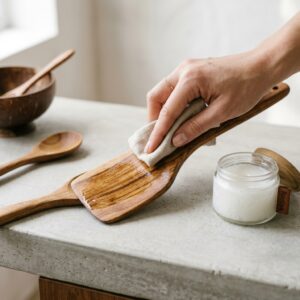
Just as leather benefits from conditioning, wood benefits from oil.
- Make sure the item is completely dry.
- Apply a thin layer of food-safe oil, such as food-grade mineral oil or a wood conditioner blended with beeswax.
- Let it absorb for several hours or overnight, then buff off any excess.
- Repeat roughly once a month, or whenever the surface looks pale or dry.
Avoid cooking oils like olive or vegetable oil, which can turn rancid over time.
Keep Them Fresh
- Deodorize with a rub of lemon and coarse salt, especially after garlic or onion.
- Treat stains with a paste of baking soda and water.
- Store smartly in an open crock or on a rack with airflow, away from direct heat and the stove’s steam.
- Avoid extremes. Don’t leave wooden tools resting in a hot pan or in strong sun for long periods.
With this small ritual, a wooden spoon can last for many years and become something you’d happily pass down.
Style Meets Sustainability: Decorating an Eco-Minimalist Kitchen
One of the quiet joys of plastic-free living is how beautiful it looks. Natural materials bring a softness that manufactured objects rarely match, and thoughtful sustainable kitchen decor doesn’t require adding more. It requires choosing better.
Let Warm Tones Lead
Wood, coconut shell, and stoneware share an earthy palette of honey, walnut, sand, and clay. Pair them with neutral walls, and the space feels grounded and serene.
Style Your Countertops with Intention
- Keep utensils in a ceramic crock beside the stove, where they double as a sculptural detail.
- Place a wooden board on the counter as a permanent, everyday accent.
- Group a few pieces in odd numbers, such as three jars or two bowls and a board, for balanced, unfussy arrangements.
Make Open Shelves Work Harder
Open shelving is a chance to show what you love. Stack coconut shell bowls, line up glass storage jars, and let one or two leafy stems or a small herb pot bring life to the composition. Leave breathing room, since negative space is a hallmark of minimalism.
Layer Texture, Not Clutter
Linen towels, a woven basket, matte ceramics, and grained wood create depth without visual noise. When each object is useful and beautiful, the kitchen feels calm, and everyday cooking feels a little more like a ritual.
Your Journey to a Zero-Waste Kitchen Starts Small
A plastic-free kitchen isn’t built in a weekend, and it doesn’t need to be. Begin with the tools that meet the most heat, such as your cooking utensils. Move next to storage and prep, then to the pieces that make your table feel special. Care for what you own, and let each swap be a considered choice rather than a rushed replacement.
What you gain is more than a healthier, lower-waste routine. It’s a kitchen filled with objects that feel real, warm, and made to last, which is the heart of eco-minimalism.
If you’re ready to begin, we invite you to explore Rootiya’s curated Eco Kitchenware collection, where natural materials and quiet craftsmanship come together to make sustainable living feel effortless.